
Why Summer Work Comes With Added Risk
Summer in Illinois brings long workdays, full job schedules, and a lot of equipment in motion. For contractors, this season means getting the most out of your time, team, and tools. But it’s also a time when your equipment is exposed — not just to the elements, but to risks you might not be thinking about.
Many business owners assume their commercial property insurance covers everything they need. It makes sense at first — you've got the building, maybe the vehicles, and you feel covered. But the moment your tools leave that insured location — whether they’re loaded onto a trailer or parked at a job site overnight — there’s a chance they’re no longer protected.
That’s where inland marine insurance comes in. And despite the name, it has nothing to do with water. It’s about mobility. If your equipment travels, this is the type of coverage that travels with it.
A Realistic Risk: The Overnight Job Site Theft
|
Picture this: You leave a job site with plans to pick up work the next day. Your trailer is parked securely with a skid steer and several power tools inside. Overnight, someone breaks in and takes off with thousands of dollars in gear. When you go to file a claim, your commercial property policy denies it — because the theft didn’t occur at your place of business. That’s a hard and expensive lesson. |
|
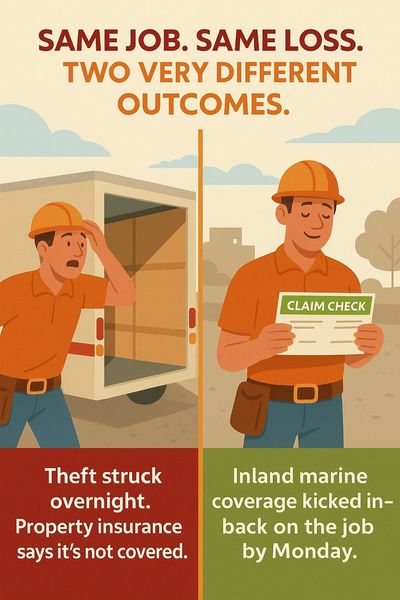
With an inland marine policy that includes an equipment floater, you'd be covered. It’s not about bells and whistles — it’s about protecting your ability to keep working without interruption.
What Inland Marine Insurance Actually Covers
Inland marine insurance is especially valuable for businesses that:
-
Move gear between job sites
-
Store tools or materials offsite
-
Install fixtures at client locations
-
Transport goods as part of their operations
If you’re running a crew, overseeing multiple sites, or delivering projects on tight deadlines, chances are you fall into one of those categories.
The protection inland marine coverage provides isn’t one-size-fits-all. It’s adaptable, which is why it’s often structured with different types of floaters. An equipment floater covers tools and machines — anything from compressors to skid steers. An installation floater kicks in when you’ve got materials en route or waiting for install. Motor truck cargo coverage protects the materials you’re hauling. And if you’re holding a client’s property — say, at a repair shop — bailee’s coverage is designed for that.
This kind of flexibility is what sets inland marine coverage apart. It fills in the gaps that traditional property insurance leaves behind, especially for mobile businesses.
More Work, More Movement, More Exposure
And summer, as busy as it is, also increases the chance for something to go wrong. Job sites stay active longer, equipment moves more frequently, and storms can cause real damage. Theft tends to spike during busy seasons when gear is out and unattended more often. The combination of more movement and higher exposure makes inland marine coverage a smart move this time of year.
Partnering With the Right Insurance Team
At Loman-Ray Insurance Group, we work closely with contractors, installers, and service professionals across Illinois. We don’t just offer policies — we help you figure out what your operation really needs to stay protected. Do you rent equipment? Do you store it on-site or take it home? Do you handle materials that don’t belong to you? These questions help shape the right kind of inland marine policy.
We know insurance isn’t your favorite part of running a business — but it’s one of the most important parts of keeping your business running. With the right inland marine coverage, your equipment works as hard as you do — without leaving you financially exposed if something goes wrong.
Be Ready Before the Season Gets Busier
As summer picks up, now’s the time to make sure your coverage is keeping up. Reach out to a Loman-Ray agent today and get a policy review. We'll walk you through your risks, explain where coverage may fall short, and help you find a plan that works with how you operate — not just where your business is based.